

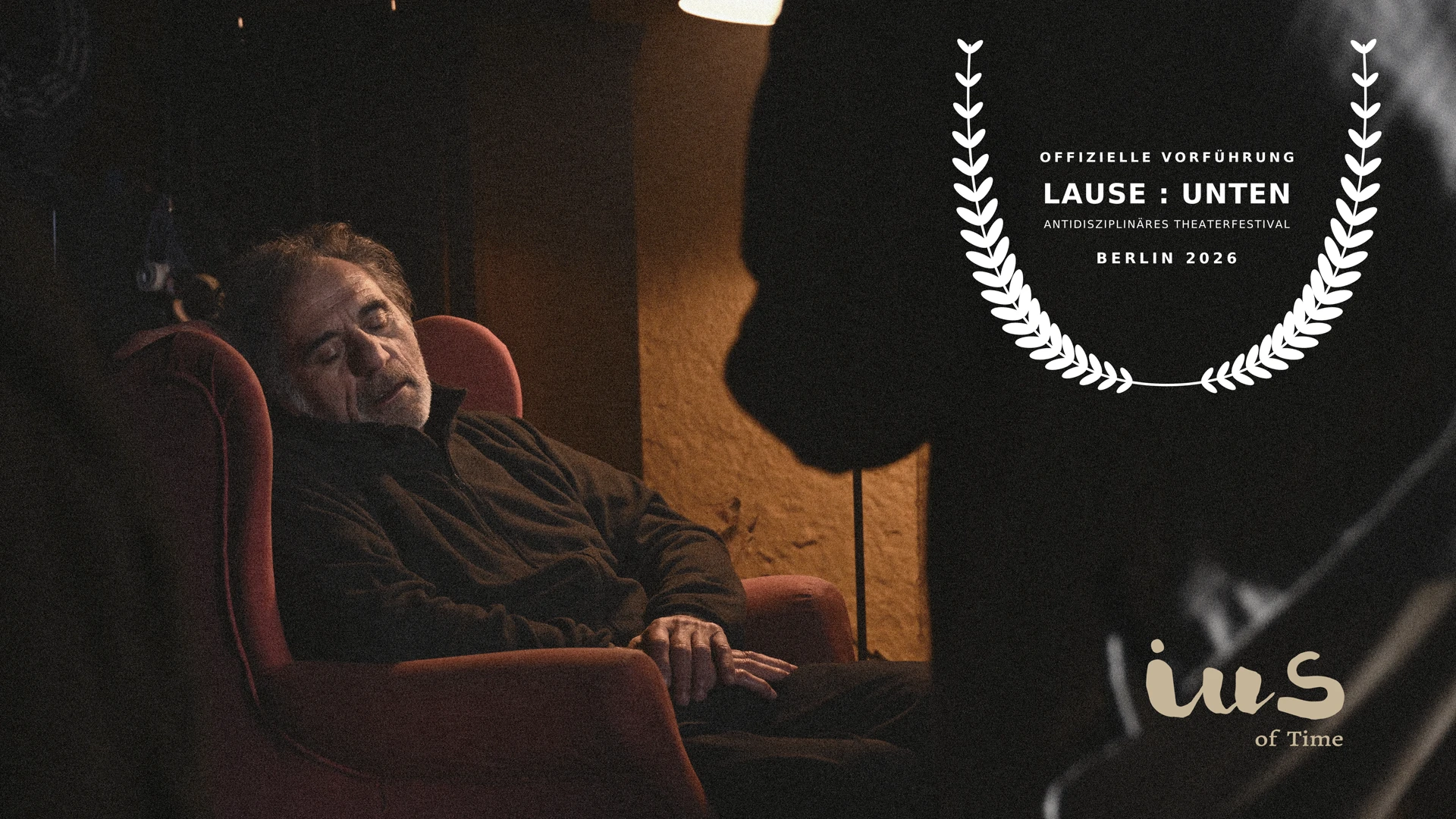
More than a festival screening, this is an invitation into a programme where cinema becomes part of a wider conversation about memory, resistance and the spaces that make independent culture possible.
IUS of Time, co-directed by Roberto F. Canuto and Xu Xiaoxi, travels to Berlin this week as part of THE URGE, a curated short film programme presented by the Positively Different Short Film Festival (PDSFF) of Athens. The screening takes place during LAUSE : UNTEN – Antidisciplinary Theater Festival, held at Die Lause in Berlin-Kreuzberg.
Rather than being selected through an open call, the invitation emerged after the LAUSE : UNTEN team discovered the film during its official selection at the 7th Positively Different Short Film Festival in Athens earlier this year and proposed bringing it to Berlin.
The screening also marks several firsts for the film: it is the first time IUS of Time has been presented within an interdisciplinary arts festival rather than a film festival, and the first time it has formed part of a benefit event, where all proceeds support the independent cultural space hosting the programme.
IUS of Time at LAUSE : UNTEN — Berlin 2026
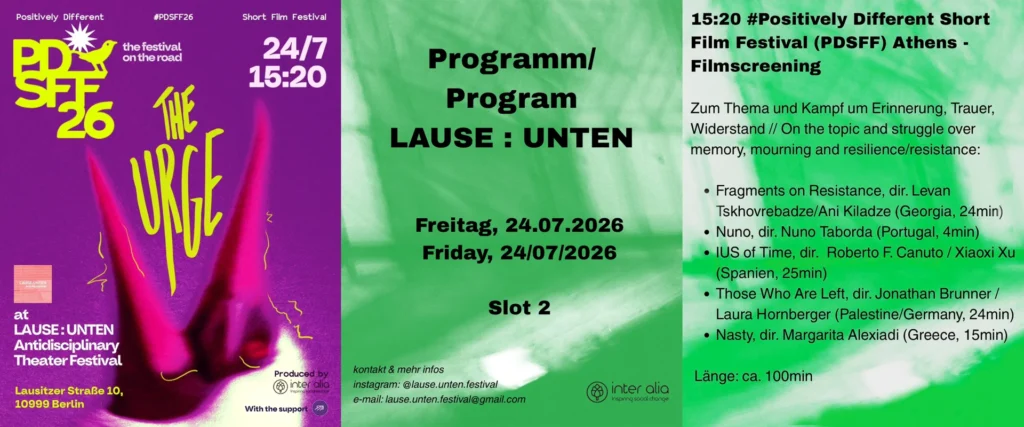
THE URGE: Memory, Mourning and Resistance
Rather than grouping films by country, genre or style, THE URGE brings together five works connected by shared questions of collective memory, mourning, silence and resistance.
The programme includes:
- Fragments on Resistance — Levan Tskhovrebadze & Ani Kiladze (Georgia)
- Nuno — Nuno Taborda (Portugal)
- IUS of Time — Roberto F. Canuto & Xu Xiaoxi (Spain)
- Those Who Are Left — Jonathan Brunner & Laura Hornberger (Palestine/Germany)
- Nasty — Margarita Alexiadi (Greece)
Within this context, IUS of Time is read alongside films dealing with occupied territories, political violence and personal loss. Xuan — the ageing cheesemaker living under the weight of decades-old rumours in a depopulating Asturian village — becomes part of a wider reflection on what communities choose to remember, what they decide to forget, and who is expected to carry silence on behalf of others.
It is a dialogue the film had not entered before, and one that expands its meaning beyond its original cultural context.
A Festival That Exists to Defend the Space It Happens In
Running from 23 to 25 July 2026, LAUSE : UNTEN describes itself as an antidisciplinary theatre festival, moving between theatre, dance, performance, visual arts, readings, concerts and cinema while deliberately refusing fixed artistic categories.
The festival revolves around Die Lause, a self-managed cultural space in Berlin-Kreuzberg that hosts artists, creative businesses, political initiatives and community organisations.
More than a venue, Die Lause has become a symbol of resistance against displacement and the growing pressures affecting independent culture in Berlin. Through the #LauseBleibt campaign, its community continues to oppose eviction, gentrification and cuts to cultural funding.
The festival itself is therefore a benefit event: all proceeds contribute directly to the continued existence of the space. Supporting the festival also means supporting the community that inhabits it.
From Athens to Berlin: When a Film Continues Travelling
The Positively Different Short Film Festival, organised in Athens by the Greek NGO Inter Alia, is built around principles of intersectionality and social inclusion, presenting films by and about communities whose voices are often underrepresented because of gender, sexuality, ethnicity, race, disability, class or religion.
Over recent years, the festival has evolved into a trans-local platform, with collaborations and screenings extending to cities including Istanbul, Belgrade, Sofia, Zagreb, Dakar and Nicosia. Berlin now joins that network.
The journey of IUS of Time to Berlin illustrates how films sometimes continue travelling long after a festival has ended — not through new submissions, but because someone in the audience decides they deserve to be seen again.
Three Screenings in Germany
Berlin marks the film’s third screening in Germany, following its participation in the 30th OpenEyes Filmfest Marburg (2025) and the 42nd Schwule Filmwoche Freiburg (2026), where it competed in the Fabulous Shorts I programme.
Germany has become one of the countries where IUS of Time has found particularly diverse exhibition contexts, ranging from LGBTQ+ film festivals to independent cultural initiatives.
With more than 67 international festival selections across five continents and seven festival awards and distinctions — including the Director’s Choice Award at the 45th Thomas Edison Film Festival (USA) and Best Cinematography at the 4th Silicon Valley Queer Film Festival (USA) — the film continues to reach audiences well beyond the LGBTQ+ circuit where its international journey began.
Recent screenings include the 15th Sofia Pride Film Fest (Bulgaria) and the 10th Out & Loud – Pune International Queer Film Festival (India).
A Film Shaped by Memory, Landscape and Emotional Encounter
Set in the rural landscapes of Asturias, northern Spain, IUS of Time follows Luca, a young photographer searching for something he cannot yet name, and Xuan, an ageing cheesemaker carrying decades of silence and emotional restraint.
Filmed in the Picos de Europa, the cheese caves of Cabrales and villages such as Biedes or Asiegu, the landscape functions not simply as scenery but as an emotional and narrative presence.
Developed alongside the companion films Blow Down and Sunset in Paris, conceived as the Sketches of IUS, the project explores memory, belonging, masculinity and intergenerational connection through a cinematic language rooted in place.
Berlin is a case in point: a story from a handful of Asturian villages, screened in a Kreuzberg courtyard that is fighting to remain what it is, next to films from Georgia and Palestine. The landscape does not shrink the story. It gives it somewhere to stand.
More Information
Berlin becomes another stop in the growing international journey of IUS of Time, which has now been officially selected at 67 festivals across five continents.
- Official page of IUS of Time
- Complete list of festival selections and awards
- 2025 Festival Journey
- Positively Different Short Film Festival – Athens
- Die Lause – Berlin-Kreuzberg
- Watch the official trailer